
CSU-TAPS Irrigation Timing Matters
CSU-TAPS farm management competition data analysis offers practical insights about how irrigation efficiency relates to corn yield.
By CSU-TAPS research team, presented by Dr. Wubengeda Yilma at the 2026 UCOWR conference in San Antonio, Texas
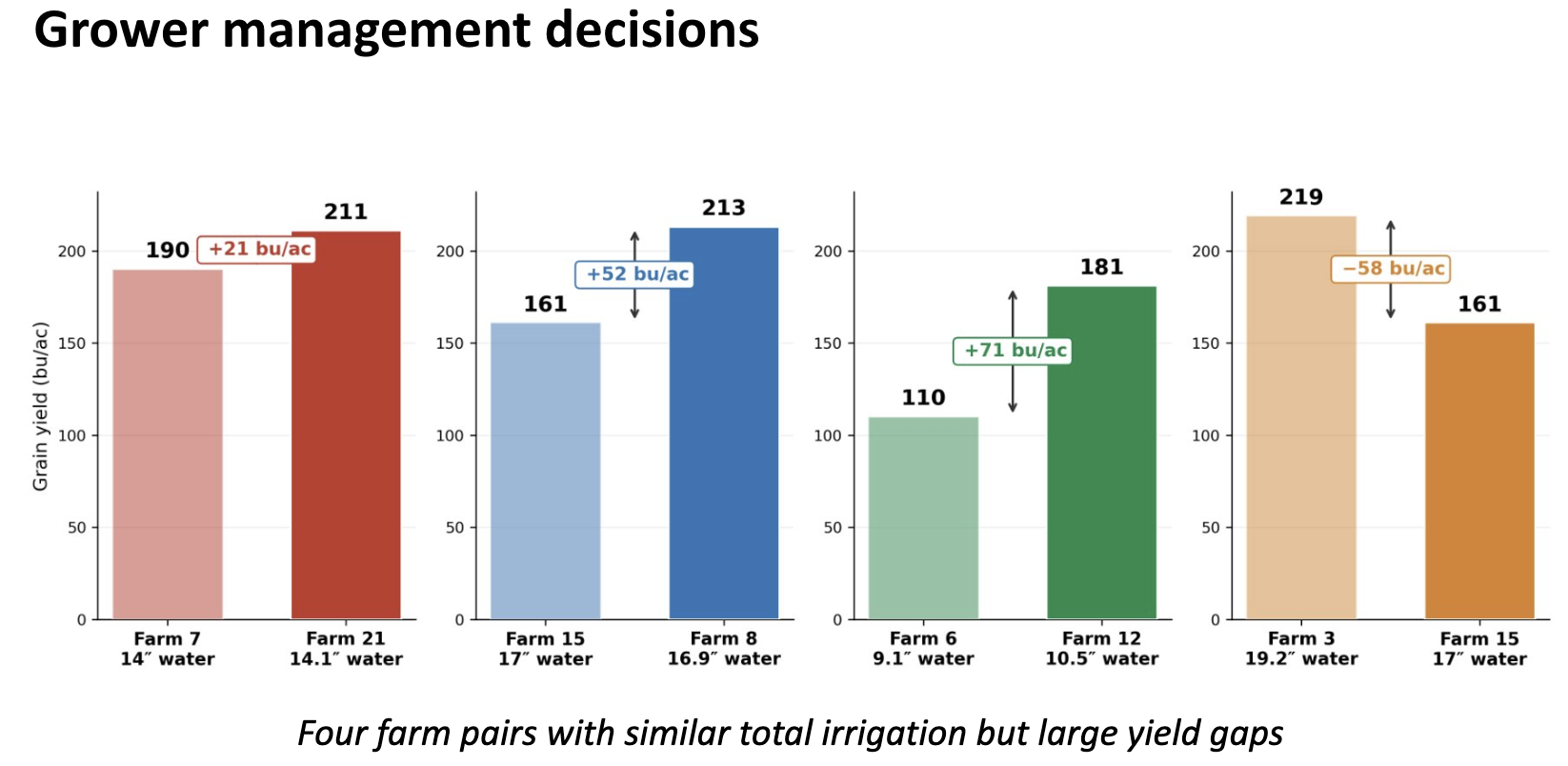
Yield differences between farms with similar seasonal irrigation totals in the 2024 CSU-TAPS competition led to the CSU-TAPS team’s research and development of an “event level attribution” framework of analysis.
When water is applied to a corn crop – and not simply how much – also impacts final harvest yield; that is a key finding from recent data analysis from the Colorado State University Testing Ag Performance Solutions (CSU-TAPS) farm management competition.
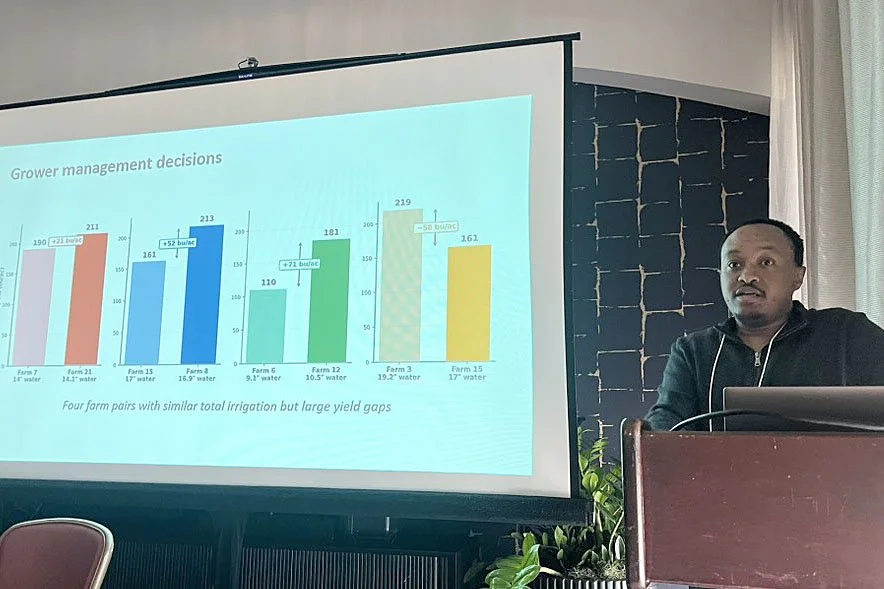
Dr. Wubengeda Yilma presented this analysis from the 2024 CSU-TAPS farm management competition at the 2026 UCOWR conference.
The CSU-TAPS sprinkler corn competition brings together producers, researchers, and ag industry partners to provide participants with an innovative way to test irrigation and nitrogen management strategies under real-world conditions. The unique farm competition format (which has teams competing side-by-side, in the same field) also doubles as a research framework, generating valuable datasets showing differences in farmer management style and decision making.
In the 2024 competition, 27 farmer-led teams each managed a set of three replicated plots in the field, making independent decisions on irrigation and fertigation throughout the growing season. The field is located at the CSU Agricultural, Research, Development, and Education Center (ARDEC) South research farm facility in Fort Collins, Colorado. The field site is located in a semi-arid region that receives on average about 6.5 inches of precipitation annually during the growing season.
As in previous competition years, similar seasonal irrigation totals in 2024 often produced dramatically different yields even when hybrid and seeding rates were the same or similar.
To investigate the reasons underlying these yield differences, the CSU-TAPS research team developed a novel “event-level attribution” time series model. Rather than analyzing total seasonal irrigation input amounts alone, the approach evaluates each irrigation and fertigation event as well as its contribution to final yield.
The analysis involves three key steps for each competition 3-plot “farm:”
1. Link individual irrigation and fertigation applications to changes in the field plant canopy, as measured by NDVI (Normalized Difference Vegetation Index) drone-captured multispectral imagery.
2. Link season-long NDVI time series to final grain yield to identify the growth stages where greenness most strongly impacts yield.
3. Attribute a per-inch yield impact to each irrigation application to account for the influence of irrigation timing from the effect of total irrigation for the season.
Irrigation Drives Canopy Greenness; Timing Influences Yield
The approach generated valuable insights for producers and competitors.
Irrigation had a clear effect on canopy greenness. The competition’s irrigation decisions began on June 12. Each irrigation made the canopy visibly greener, as seen in the NDVI imagery, and that effect faded gradually rather than disappearing between drone flights. About 60 percent of the greenness gain from one irrigation event was still present a week later, and roughly a third of the greenness gain was still evident two weeks later.
That greenness carryover effect is why timing matters beyond the week in which the water is applied. An irrigation application made ahead of a critical growth stage is still supporting the crop when that stage arrives.
Not all growth stages contribute equally to final yield. The study identified two distinct windows when canopy condition and irrigation matter most: early August, when kernel number is determined; and early September, when kernels accumulate weight. After early October, or once the crop reaches physiological maturity, additional water provided no measurable yield benefit.
In linking yield responses to individual irrigation events, the analysis found that poorly timed water is wasted. Irrigation applications timed during critical growth stages can translate into returns of up to approximately 33 more bushels per acre, per inch of water.
Total irrigation volume remained the dominant factor influencing yield, explaining about 72.7% of yield variation across farms. However, irrigation timing contributed an additional 8.4% of yield variation beyond total water volume.
Multiple Paths to Performance
The team also identified distinct management strategies among participants. Some farms achieved high yields through both high irrigation volume and effective timing, and others through increased water use that compensated for less precise timing. Farms with well-timed irrigation but insufficient total water achieved moderate yields. The lowest-performing farms had both poor timing and insufficient irrigation.
Although multiple pathways lead to high yield, poor irrigation timing is consistently associated with lower productivity.
Future Implications for Farmers
For producers, the takeaway is clear: improving irrigation timing offers a tangible, immediate opportunity to increase efficiency and productivity without necessarily increasing total water use.
One limitation of this analysis is that precipitation was not included as an input to the “event level attribution” model. The model links canopy greenness to irrigation and fertigation events only, so any rainfall the crop received during the 2024 season was absorbed into the model's unexplained variation rather than accounted for directly. Future analysis will incorporate on-site precipitation as a model input, so that canopy response can be attributed to the total water a crop received rather than to applied irrigation alone.
The CSU-TAPS team intends to expand this analysis across multiple years, partnering with other TAPS Network competition sites to assess these effects under different regional conditions. They also aim to integrate soil nitrogen data to better understand fertigation impact potential.
The end goal is to apply findings from this framework within algorithms for real-time irrigation scheduling tools that farmers can put to use.
These findings were presented by Wubengeda “Wub” Yilma, Ph.D., CSU-TAPS precision irrigation manager, at the 2026 Universities Council on Water Resources (UCOWR) annual meeting in San Antonio, Texas, “Linking Irrigation Timing & Corn Yield using NDVI Time Series and ARX-Ridge Regression.”