2026 Master Irrigator Summit Convened 50 Water Leaders from 15 States
The growing Master Irrigator program network gave center stage to farmer-led precision irrigation education at Oklahoma’s Quartz Mountain State Park.
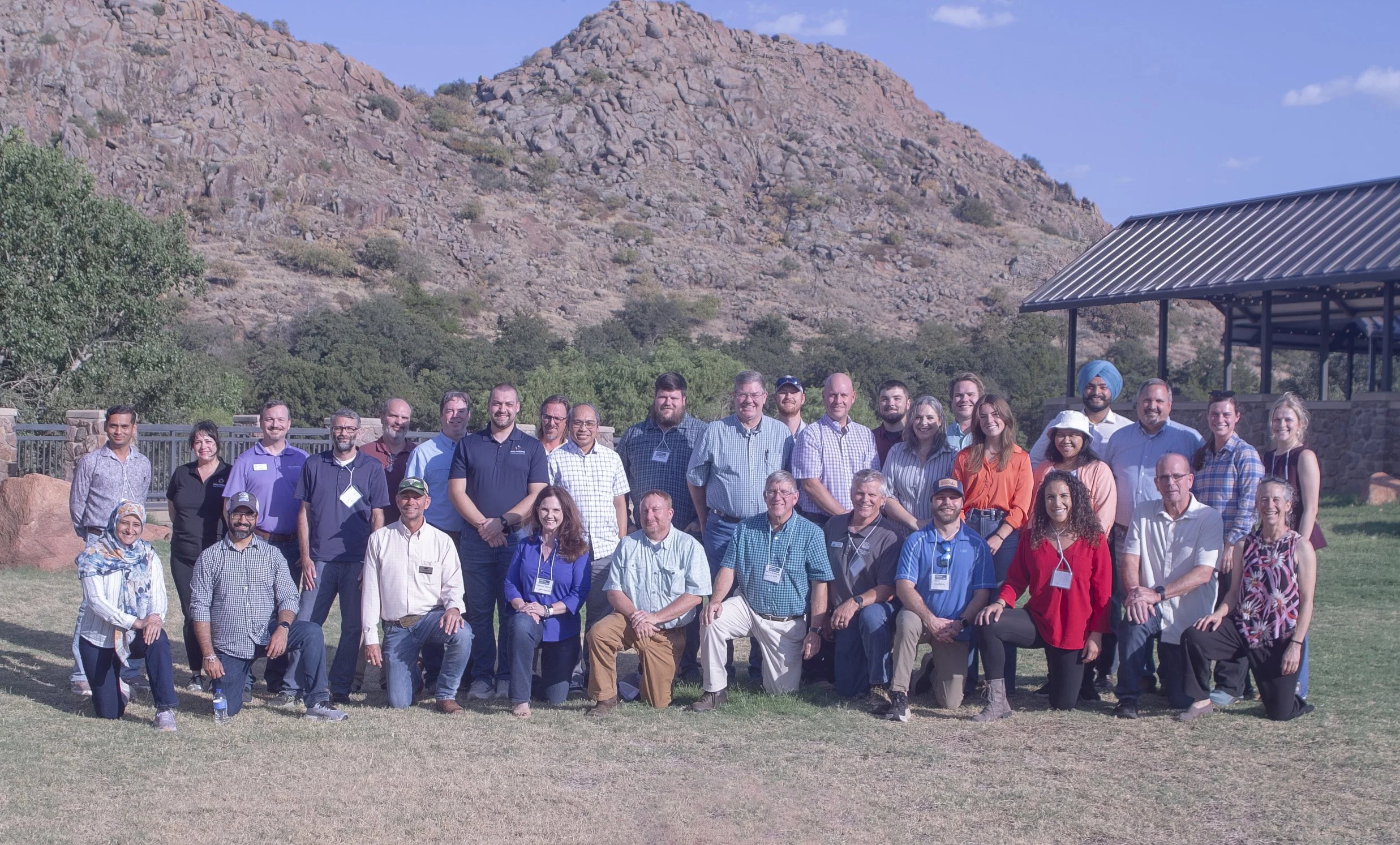
2026 Master Irrigator Summit attendees in person at Quartz Mountain State Park Lodge in Lone Wolf, Oklahoma Photo by Christine Hamilton
FORT COLLINS, CO – August 19, 2026 – More than 50 ag water leaders representing existing and emerging Master Irrigator programs spanning 15 states – along with other key stakeholders – attended the 3rd Annual Master Irrigator Summit, August 10-12 at Quartz Mountain State Park Lodge in southwest Oklahoma.
The Master Irrigator (MI) Summit is designed to support knowledge exchange among coordinators and advisors involved in leading state-level MI programs, which help farmers improve water management and conservation while remaining productive and profitable. Attendees included producers, ag educators, researchers, state and federal conservation professionals, and ag industry representatives from across the U.S.
"This has become an important annual meeting for Master Irrigator programs, both from programs already in place and also those states interested in starting one,” said Sumit Sharma, Oklahoma State University extension specialist for High Plains irrigation and water management, and director of the OSU Master Irrigator program. “By sharing experiences, resources and ideas, we can strengthen these Master Irrigator programs that are making a difference in water-stressed ag communities.”
Hosted by the OSU Master Irrigator program, the 3rd Master Irrigator Summit was coordinated as a collaboration led by Colorado State University’s Irrigation Innovation Consortium and Oklahoma State University – including Sharma; Kevin Wagner, OSU professor and director of the Oklahoma Water Resources Center; Amy Kremen, IIC associate director; Tracy Beck, OWRC program specialist; and Christine Hamilton, IIC project manager and communications coordinator.
Event sponsors included USDA Natural Resources Conservation Service, Irrigation Innovation Consortium, AquaSpy, Arable, Spheros Environmental, and Sustainable Hydrology.[AK1]
The 15 participating states were: Arkansas, Arizona, California, Colorado, Florida, Georgia, Idaho, Kansas, Minnesota, Mississippi, Nebraska, Oklahoma, Oregon, Texas, and Utah.
The summit opened with state program updates of accomplishments, lessons learned and challenge areas. Subsequent sessions included curriculum development, evaluating and communicating program impacts, identifying funding opportunities, expanding the use of technology and decision-support tools, opportunities for future growth, and more.
Highlights included:
The Southwest Oklahoma Irrigation & Water Tour showcased water management in this semi-arid region. Stops included Lugert-Altus Irrigation District hosted by Tom Buchanan, irrigation district manager; Muller Family Farm in Jackson County, hosted by respected producer Matt Muller; and Oklahoma State University’s Southwest Research and Extension Center in Altus, hosted by Mike Schultz, station superintendent.
Tools and data demonstrations included:
· OASIS (Oklahoma Agricultural Scientific Irrigation Scheduler) demonstration by Sumon Datta, assistant professor and irrigation engineer at Oklahoma State University
· OpenET applications available for producers, with A.J. Purdy, senior research scientist, Cal State University Monterrey Bay-NASA Ames Research Center
· Spheros Environmental digital mapping of the Ogallala Aquifer, with Jim Roberts, Spheros principal hydrogeologist
Evening panel discussions provided direct engagement with producers, industry partners, and national conservation leaders. Oklahoma producers Scott Arthaud (Keyes, OK) and Mark Deleon (Erik, OK) joined Martha Zwonitzer of Arable to discuss on-the-ground irrigation challenges and perspectives on Master Irrigator programming.
A second panel featured national perspectives from the following conservation and ag industry leaders: Clint Evans, USDA-NRCS state conservationist for Colorado; Trey Lam, Oklahoma Conservation Commission executive director; Marla Peek, Oklahoma Farm Bureau senior director of regulatory affairs; and Keith Sides, USDA-NRCS state irrigation engineer for Texas.
“When we met for the first time in 2024 in Nebraska, we had six programs nationwide and representatives from nine states attending,” Kremen said. “In 2025, we met in Arkansas with 13 states involved, and now 15 here in 2026. Collaboration among states is becoming increasingly important for sharing successful approaches and addressing common challenges.
“The organic growth of these programs is a testament to their effectiveness in being farmer-focused and farmer-led and adapted to regional needs and challenges in irrigation management, while elevating how conservation and farm profitability are linked,” Kremen added. “Meeting in Oklahoma at Quartz Mountain State Park this year provided a perfect setting to focus on water resource challenges for growers in the Lake Lugert-Altus area.”
About Master Irrigator: Master Irrigator is a training course offering 24+ hours of instruction focused on precision irrigation management for profitable agricultural outcomes and success with water conservation. Local, producer-led advisory committees tailor programs to regional needs, drawing on hydrology, agronomy, engineering, technology, and business planning expertise. MI emphasizes peer-to-peer and hands-on learning, interactive discussion, networking, and practical precision agriculture strategies to reduce costs, inputs, and labor while improving water use efficiency.
Founded by the North Plains Groundwater Conservation District, Dumas, Texas, in 2016, subsequent MI programs have followed its format, with established programs helping new ones start and develop curriculum suited to their participants’ local needs and interests. Leadership in coordinating state MI programs comes from university extension staff, non-profit organizations, and conservation districts.
Graduates of MI programs often gain access to additional support, including technical assistance, financial incentives, and, in some states, enhanced USDA-NRCS EQIP ranking for cost sharing that helps fund advanced irrigation water management practices, system updates, and access to technologies. Data shows that the majority of program graduates implement meaningful changes in their operations, influencing water management across over 100,000 acres annually. Find a state program here.
About Oklahoma Water Resources Center: OWRC strives to empower informed decision making and enriching understanding of Oklahoma’s most critical water management issues through engagement, education, and actionable science. Learn more at water.okstate.edu.
About the Irrigation Innovation Consortium: IIC supports the development, testing and improvement of advanced irrigation management tools and strategies for water manager success. Part of Colorado State University’s College of Agricultural Sciences, IIC projects include a multi-state project supporting U.S. expansion of two producer-driven programs: Master Irrigator and Testing Ag Performance Solutions. The Multi-State TAPS and Master Irrigator Project includes five universities – Colorado State, Kansas State, Oklahoma State, University of Nebraska-Lincoln, and Texas A&M AgriLife – with major funding support provided by USDA Natural Resources Conservation Service. Learn more at irrigationinnovation.org.